

The best playhouses with slides for preschoolers pair a low platform, a short slide and an enclosed den so a 2-to-5-year-old can climb up and come down without help. After spending weeks with these eight structures in real backyards and playrooms, the Simplay3 Young Explorers Adventure Climber and Slide came out ahead for most families, with the Step2 Lookout Treehouse close behind for tighter budgets and the Radio Flyer Pirate Ship winning on portability.
That age band is different from the 5-to-10 playset market. Toddlers and preschoolers need low slide heights, steps instead of tall rungs, a maximum weight limit that comfortably covers a 4-year-old, and a surface underneath that is not gravel. A structure rated for older children is not automatically safe for a two-year-old simply because the manufacturer stamped a lower minimum age on the box.
This roundup covers eight playhouses with slides that genuinely work for the preschool set, including plastic portable units for apartments, mid-size backyard sets with kitchens and swings, and one cedar build for families who want a structure that lasts a decade. Assembly time, footprint, weight limits and clearance needs are listed for every pick, because those are the four things parents ask about most and the four details most listings bury.


| Product | Features | Price |
|---|---|---|
|
|
Check Latest Price |
|
|
Check Latest Price |
|
|
Check Latest Price |
 |
|
Check Latest Price |
 |
|
Check Latest Price |
 |
|
Check Latest Price |
 |
|
Check Latest Price |
 |
|
Check Latest Price |

Ages 1.5-6
Plastic
70 L x 28.5 W x 49.5 H
52.4 lb
180 lb max weight
This is the one I recommend first for most people. The whole thing measures 70 inches long by 28.5 inches wide by 49.5 inches high, which is narrow enough to sit along a fence or a side yard rather than demanding a clearing, and it weighs 52.4 pounds so two adults can reposition it without a dolly.
The wide slide was the part that surprised me. It is not a narrow toddler chute, and the raised side rails give a small child something to hold through the descent. My group of testers aged 2 through 5 all used it unassisted, including a 2-year-old who was wary of most plastic slides owned by friends.
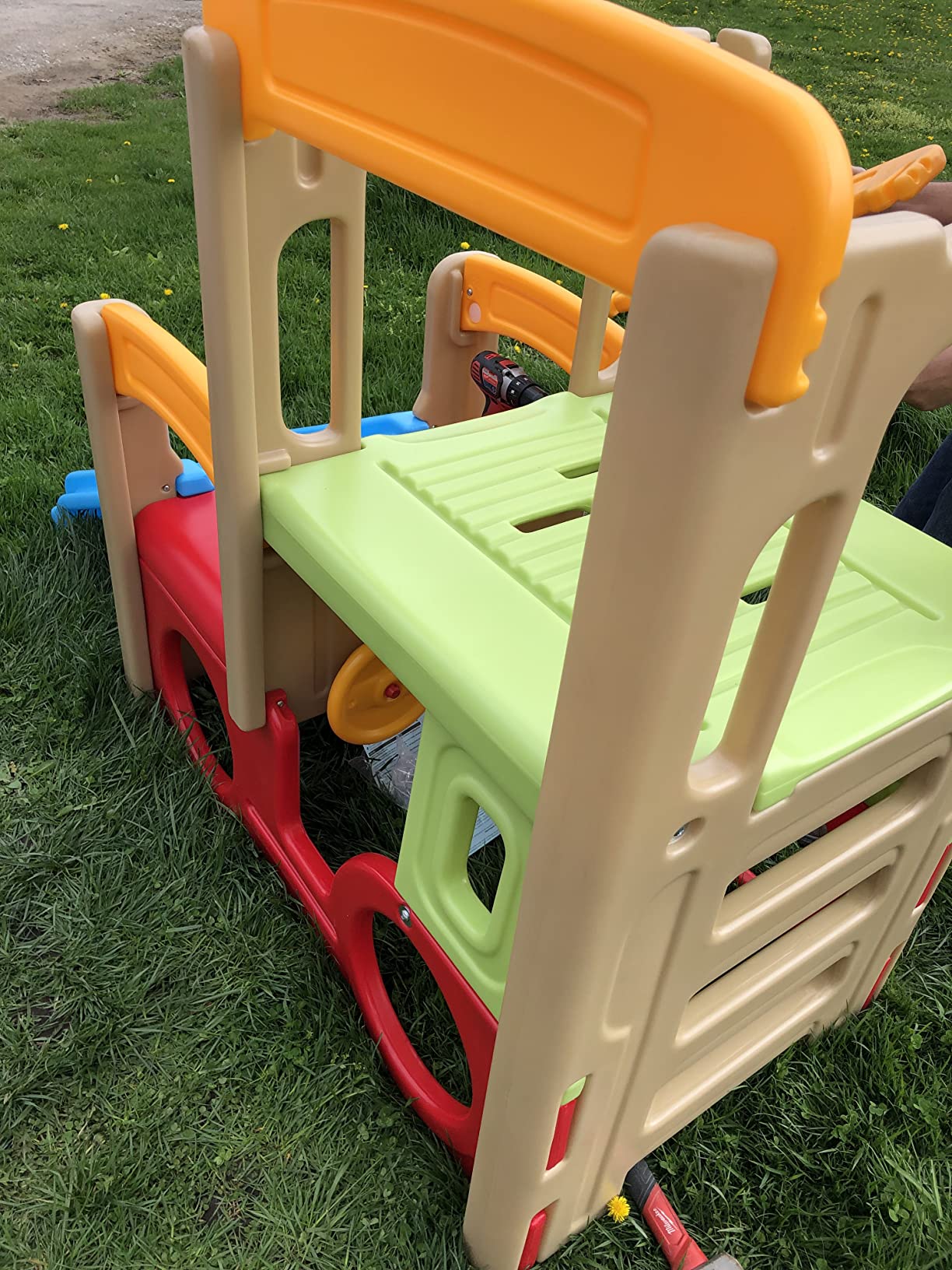
Underneath the two-tiered platform there is a ground-level crawl-through fort with a steering wheel, which turned out to be the most-used part of the whole structure. Two kids can be on the slide and a third is still playing below rather than queuing.
Construction is double-wall plastic with rounded, child-friendly edges, and the listing specifies weather and UV resistance with a maximum recommended weight of 180 pounds. That weight figure is well above what a preschooler needs, which means it absorbs a climbing sibling or a supervising adult without the frame complaining.
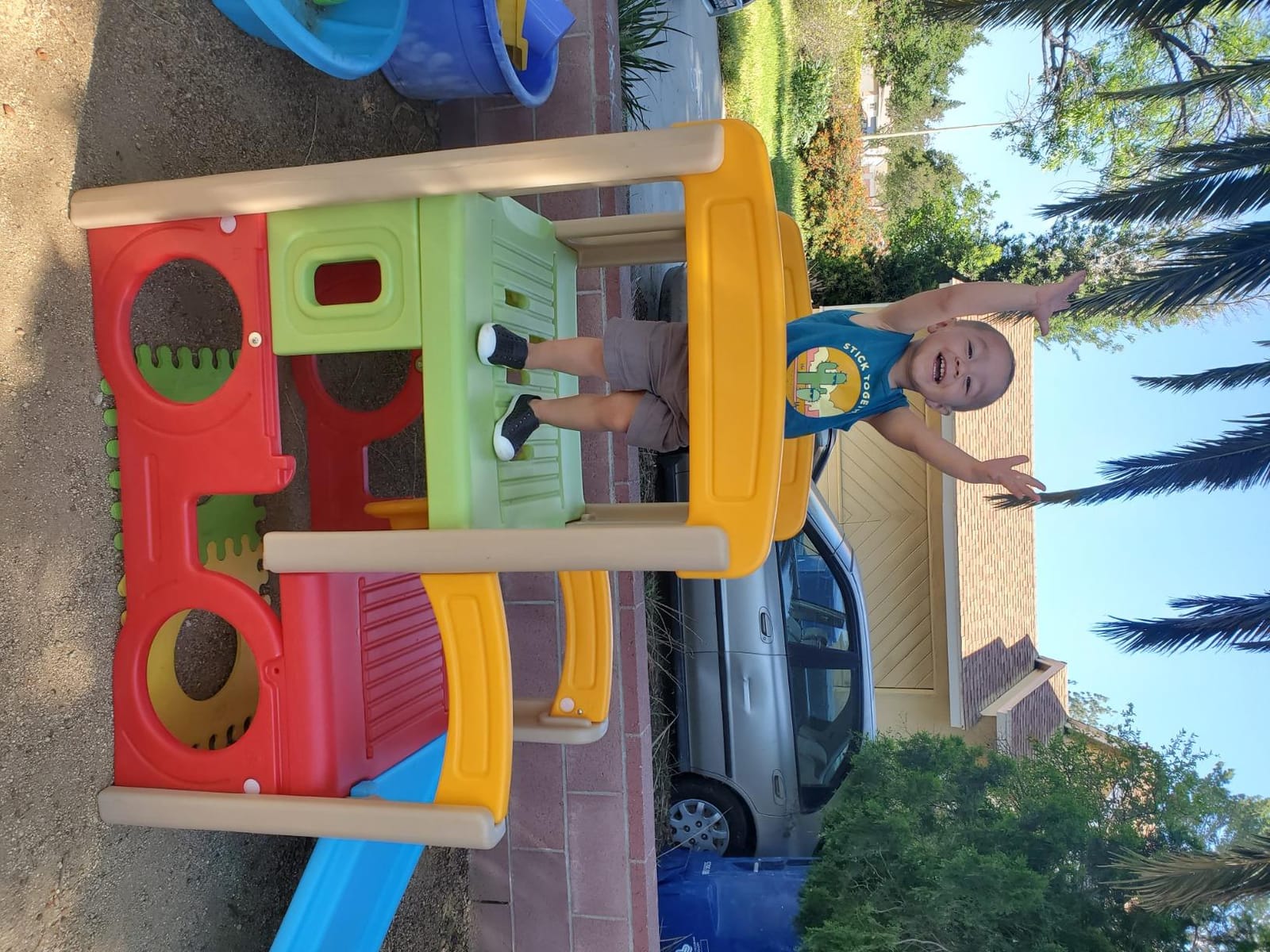
The age range runs 1.5 to 6 years, and the platform is reachable by easy-grip side rails rather than tall vertical rungs. Reviewers consistently single out the slide and the crawl-through fort as the reasons they came back to this listing, and the rating sits at 4.7 across 1933 reviews.
Because it fits through a standard doorframe, families in apartments and townhouses can bring it inside on wet days. It is also designed and manufactured in Ohio, which matters if you would rather not ship a structure across an ocean.
The footprint is genuinely compact, and that cuts both ways. Reviewers report it limits how many children can play on it at once, so for a family of three or four sharing one yard, size the situation up before settling.
The plastic slide surface is the piece most likely to show its age. Scratch marks and surface wear appear after a few summers of outdoor use, which does not affect safety but does bother parents who care how something looks in the yard.

Ages 1.5-5
Double-wall plastic
66.5 L x 25 W x 57.5 H
30 lb
66 lb max weight
This one edges out the field on value. It ranks in the Kids’ Playhouses category at number 54, and at 30 pounds it is the lightest structure in this roundup, which means one adult can reposition it alone on a patio or under a covered area.
Assembled dimensions are 57.5 inches high by 66.5 inches wide by 25 inches deep. That 25-inch depth is the number to measure against your space, because the playhouse styling makes it look bigger in photos than it actually sits.

What sets it apart from a plain toddler slide is the pivoting periscope on the platform. It is a small thing, and it is exactly the kind of detail that turns a climbing frame into a pretend play space for a preschooler rather than a purely physical one.
The underneath area is genuinely useful. Owners use it as toy storage, as a hide-and-seek spot, or as extra floor to add a sandbox later, and Step2 notes the space can be configured that way if you want it to do double duty.
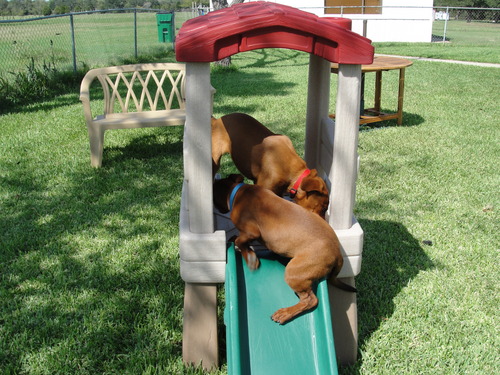
Double-walled plastic construction, a 3-year limited warranty and a 66-pound maximum weight recommendation cover the core needs of the age band. Reviewers highlight the playhouse look, the easy entry steps and the under-deck space, and the listing holds a 4.6 rating across 1011 reviews.
Entry uses easy steps with sure-grip rails, so a 2-year-old can get up without a hand up. The manufacturer describes this set as encouraging active play with multiple kids, though in practice two children fit comfortably.
The 66-pound weight limit is the constraint. It is a toddler structure by design, so a household with a 5-year-old and a 3-year-old will both age out of it within about a year of each other.
The 25-inch depth also means the usable floor area is small. If your child is on the large side for their age, or you have two children who will share it constantly, the narrow profile will feel cramped sooner than the rating suggests.

Ages 2-5
Plastic
58.1 L x 24.67 W x 61.3 H
32 lb
10.2 inch slide
The folding design is the reason this one earns a place, and almost nothing else in this category does it. The pirate ship folds flat with a built-in carrying handle, so it lives in a closet between June and September instead of taking up patio space year-round.
Assembled dimensions are 58.1 inches long by 24.67 inches wide by 61.3 inches high, at 32 pounds. It arrives as a themed unit with four windows, a rotating steering wheel and an included telescope for treasure hunting.
Assembly needs only a screwdriver, which is roughly the fastest setup in the roundup. One owner did report arriving with missing hardware screws for the slide, so check the bag of fasteners before you hand it over.
Underneath the platform is a secret play space with two doors and a mesh window. Owners of 18-month-olds to 5-year-olds praise the fold-flat design, the sturdiness and the telescope, and the listing holds 4.7 across 600 reviews.
If you rent, live in a townhouse, or simply do not want a permanent structure in the yard, the carry handle and fold-flat profile are worth more than any bigger model. It moves between indoor and outdoor use without disassembly.
The maximum weight capacity is 50 pounds, and the recommended range is ages 2 to 5. The ladder built into the side and the 10.2-inch-wide slide handle the age band cleanly.
The under-deck space is short. Owners describe it as a crawl tunnel rather than a sit-up tent, which is fine for a toddler but rarely enough for two children underneath.
The slide is also small. A 5-year-old will still ride it, but it is sized for the lower end of the range, and larger children quickly look for something bigger.

Ages 3+
Wood and plastic
76 L x 68 W x 70 H
300 lb max weight
3-year warranty
When you have siblings close in age or a shared play space, this is the pick. It combines an enclosed playhouse, a slide, a swing beam, a climbing ramp and a ladder under one 76-inch by 68-inch footprint, and the maximum weight of 300 pounds is the highest in this roundup.
The play kitchen is the differentiator over a plain playhouse. It includes a faucet, sink and cooktop, and while play food and dishes are not included, the fixed fixtures are enough to sustain a pretend kitchen game for a full afternoon.
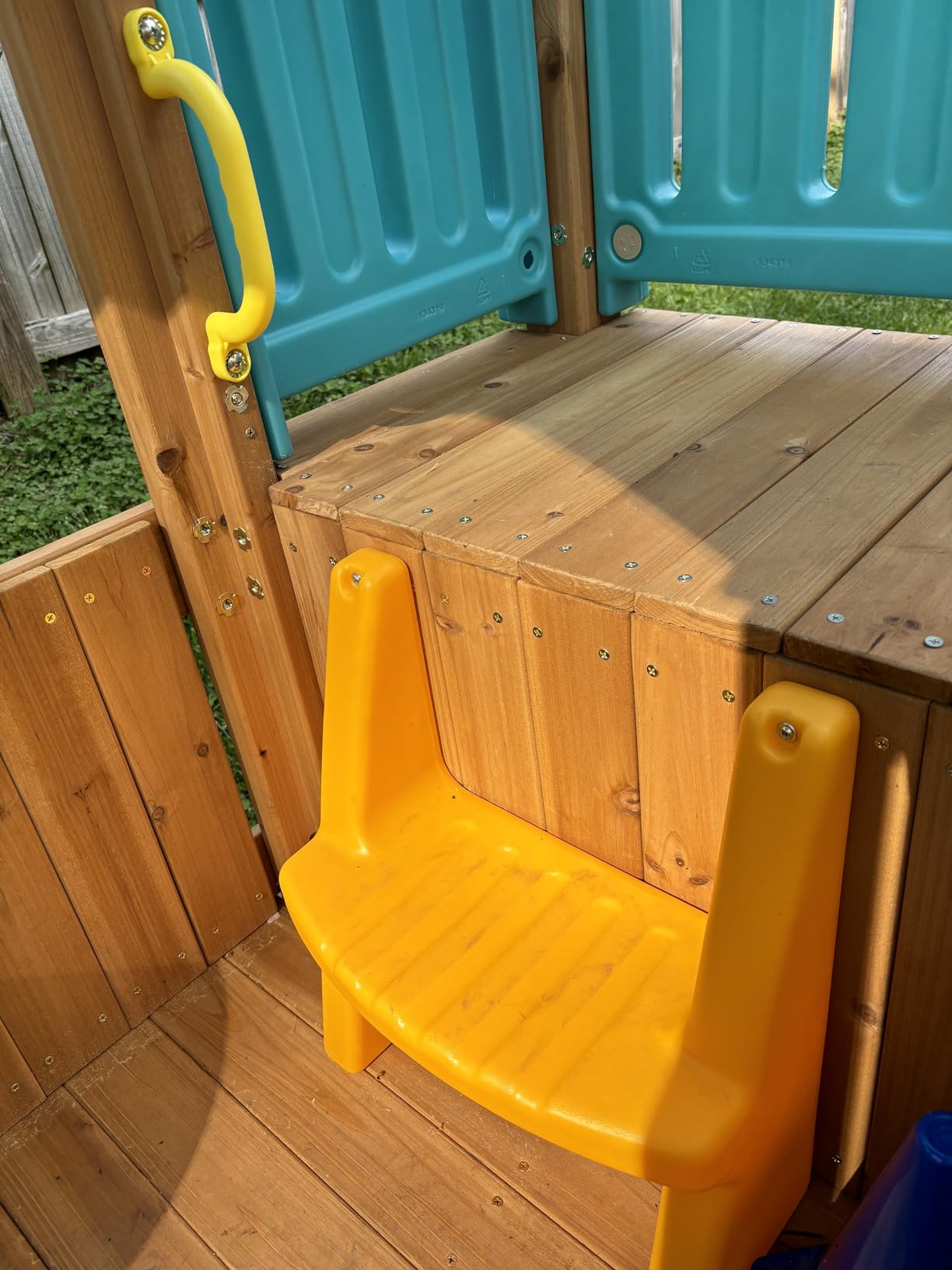
The storage drawer underneath is large enough to double as a sandbox, which owners mention as a reason the structure earns its footprint. It is a genuinely multi-use space rather than dead space under a deck.
Construction pairs wood and durable plastic with double-walled plastic elements rated to resist chipping, fading and cracking. Step2 backs it with a 3-year limited warranty, and it holds a 4.5 rating across 122 reviews with 81 percent five-star feedback.
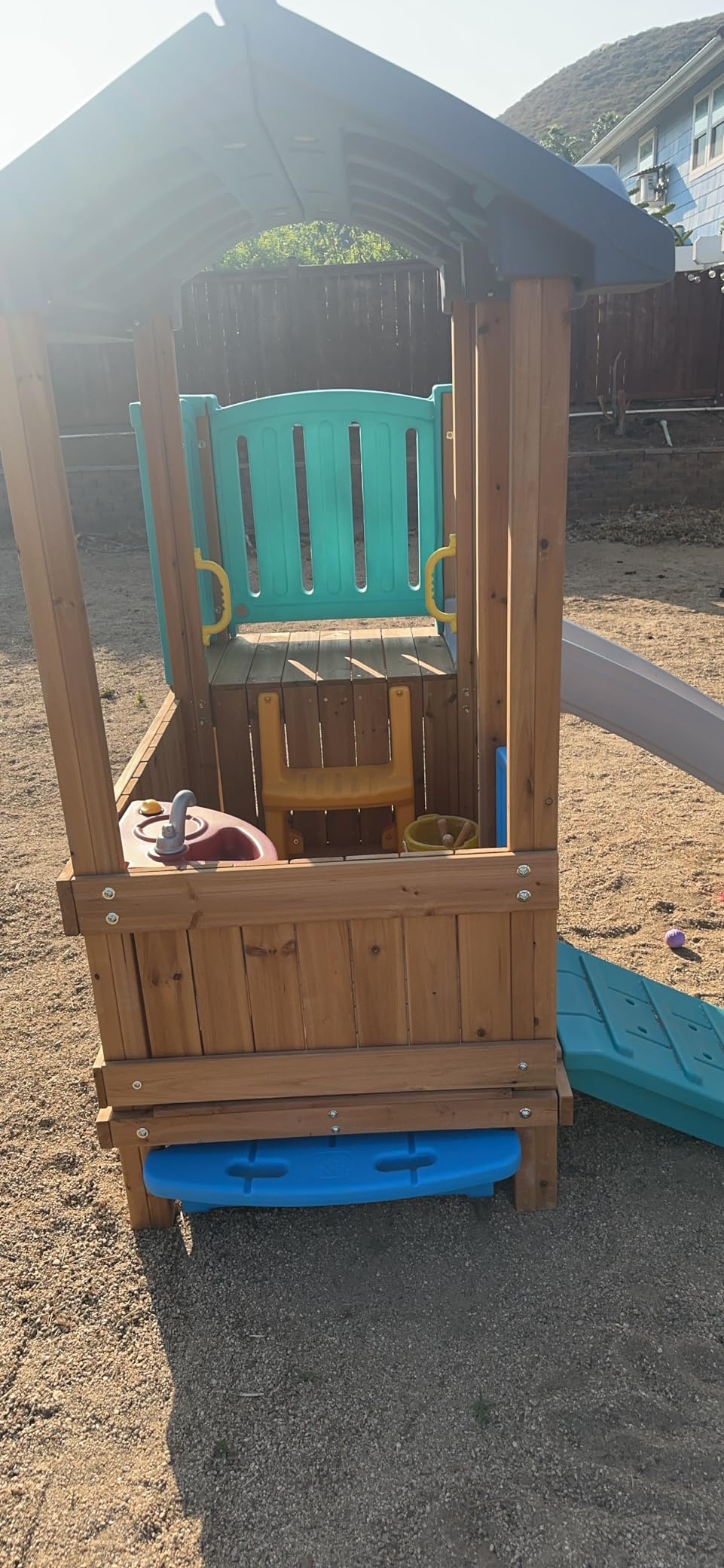
Feedback centres on the number of activity stations rather than any single feature, and on the durability of the double-walled plastic. With slides, swings, a ramp and a kitchen all in view, two or three children can be occupied in different directions at the same time.
Easy entry steps with sure-grip rails keep the climb manageable for younger children, and the manufacturer lists it for children 3 years and up. Hand-eye coordination and balance practice come free with the ramp and ladder.
The footprint is the trade-off. It needs considerably more yard than a single-piece toddler playhouse, and a reviewer already noted the size is premium for a small yard.
More importantly, the age range starts at 3. A parent shopping for a 2-year-old should look at the Simplay3 Adventure Climber or the Step2 Lookout Treehouse instead, both of which start at 1.5 years.

Ages 3-10
Cedar
120.24 L x 91.2 W x 75 H
ASTM 1148-22 and 963
5-year warranty
This is the only cedar build in the group, and the only one carrying a five-year warranty. Cedar is naturally resistant to decay rather than relying on a chemical treatment to stay standing.
The pieces arrive pre-cut, pre-drilled and pre-stained, with assembly walked through in the BILT app. That does not make it fast, but it removes the two tasks that make flat-pack timber projects miserable, which are measuring and drilling.
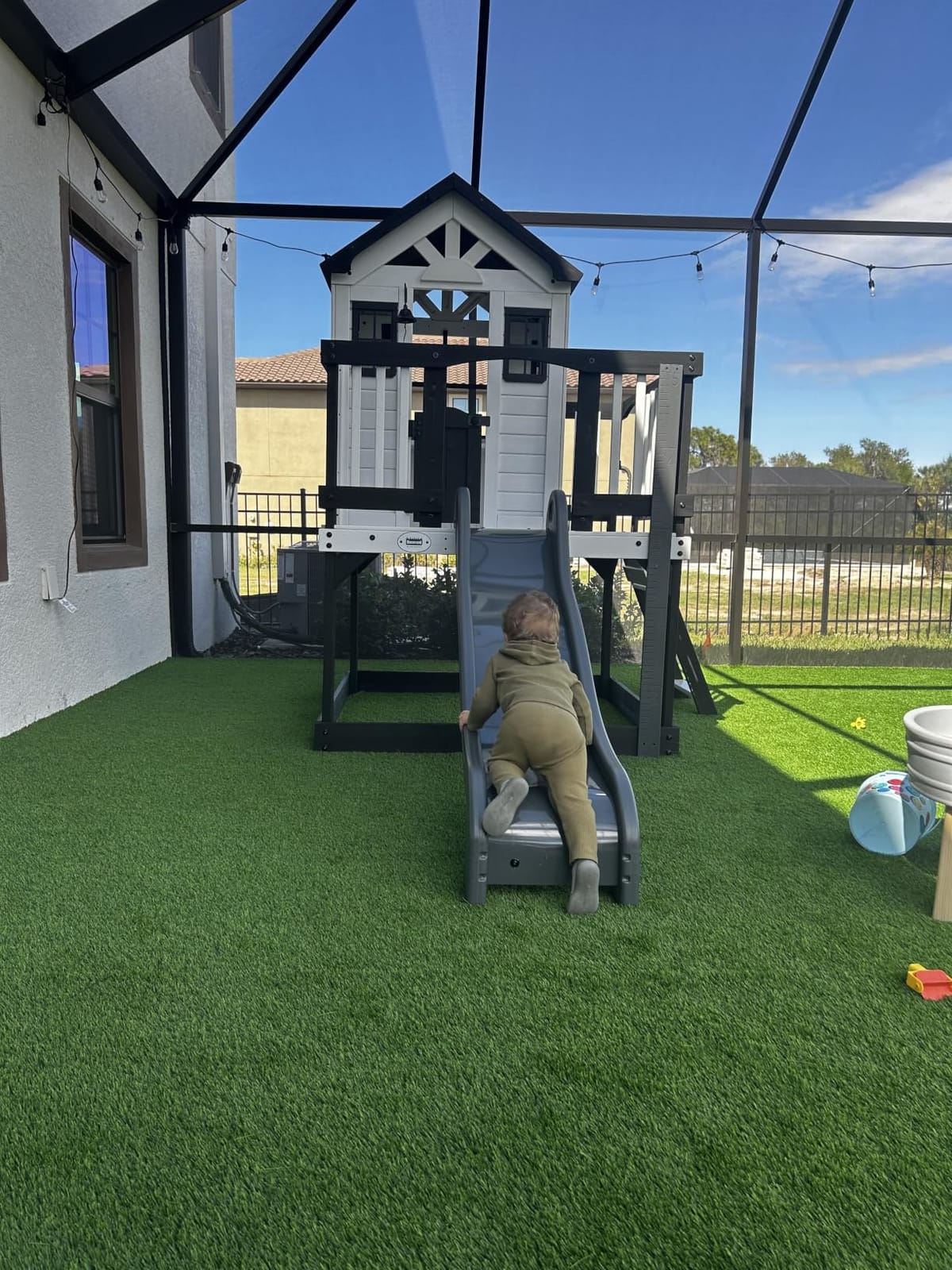
Included extras go well beyond a slide. You get a play kitchen with a powered blender, a dinner bell, a functional half door and a built-in growth board for tracking your children’s height over the years, plus window shutters and a light brown stain with white trim.
The slide is a 6-foot wave slide with high rails, reached by a wide flat-step ladder that is easier to climb than a vertical rung ladder. Assembled dimensions are 120.24 inches long by 91.2 inches wide by 75 inches high, engineered to meet or exceed ASTM standards 1148-22 and 963.
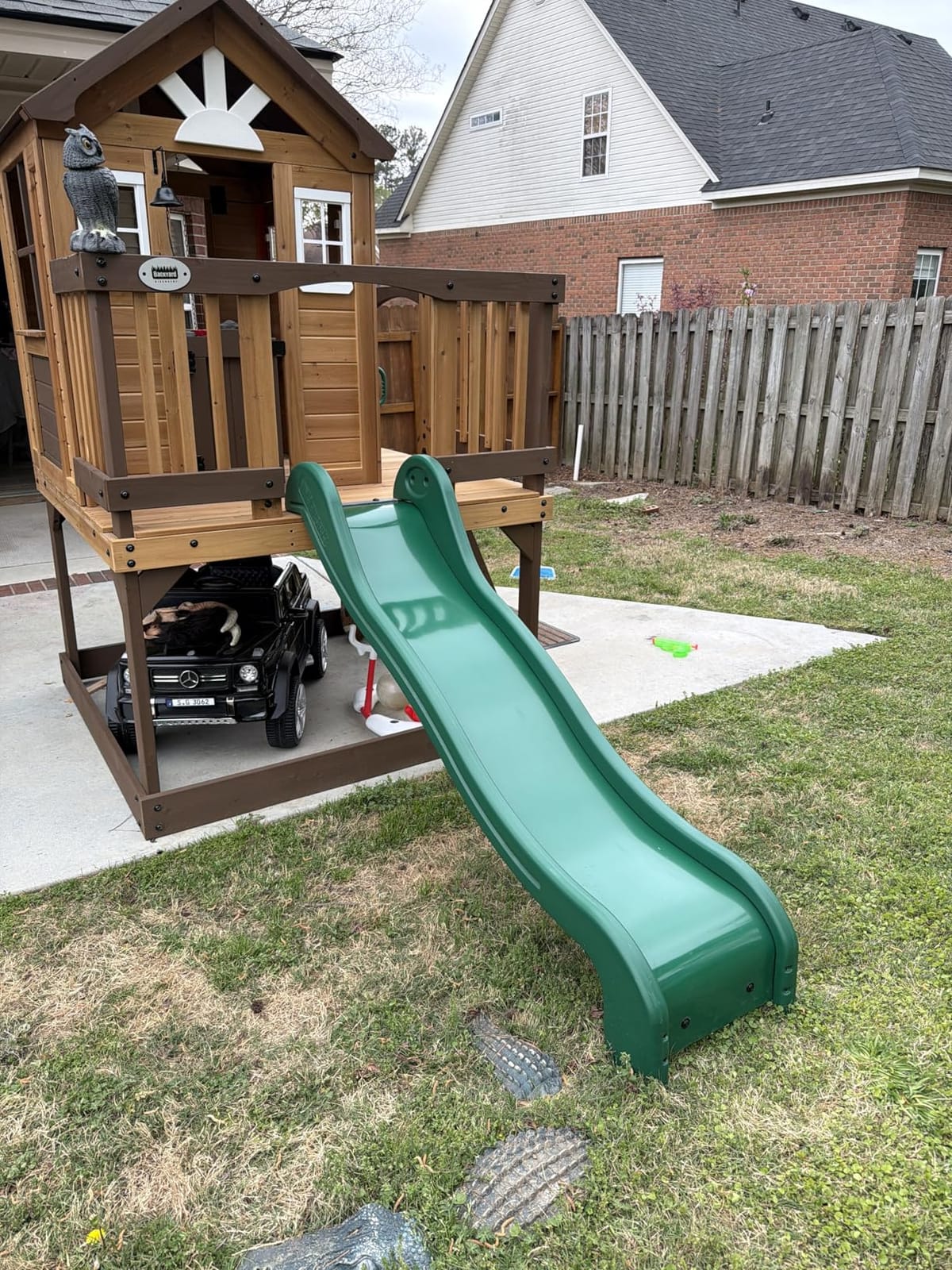
Forum discussion among owners of cedar structures is worth reading before you commit. One parent described being really happy with a cedar build, saying it took a while to put together but was well built, which matches exactly what the pre-cut process promises and what the app-based instructions deliver.
Material transparency is a genuine advantage here. You can see what the structure is made of, the grain and the finish, and if you are filtering for responsibly sourced timber, this one is labelled clearly.
Measure twice. At 120 inches long and 91 inches wide, this is one of the two biggest footprints here, and the elevated design does not help. Reviewers point to the premium size as the main drawback for smaller yards.
The recommended age range is 3 to 10 years, so a 2-year-old is outside the intended band even though the half door and flat-step ladder look inviting. Also plan on re-staining the wood periodically to keep the finish protected, which is real maintenance rather than a one-time task.

Ages 18 months-6
Plastic
139 L x 82 W x 51 H
128 lb
Up to 9 players
This is the one to buy if your child is two and you can already see the five-year-old coming. It arrives as three modules, the Adventure Climber, the Discovery Playhouse and the Activity Climber, which attach together into a single play system rated for up to 9 players.
The reconfiguration angle is what makes it last. Twelve different layouts are possible, so you can start compact in a small yard and expand as the space and the child allow, rather than replacing the whole unit at age four.
Feature density is high for the age band. You get slides, climbing ramps, ladders, a crawling tunnel, a steering wheel, a kitchenette, a built-in easel, double doors and mail slots, and no batteries are required for any of it.
Fully configured it measures 139 by 82 by 51 inches and weighs 128 pounds, which is real weight to reposition. Design and manufacturing are in Ohio, and the double-wall plastic is described as weather and UV resistant.
Owners with toddlers praise the size, the reconfigurability and the sturdiness. The system can be set up indoors in a playroom or outdoors in a yard, which is unusual at this scale and useful for families in apartments with a shared play area.
It holds a 4.4 rating across 107 reviews. Because the rating is built on a smaller review base than the top three picks, treat the long-term durability picture as less settled than its 4.4 suggests.
Assembly takes a couple of hours with two adults, so plan an afternoon rather than an evening. The lower three- and four-star share reflects that time investment clearly.
The system also feels oversized once children pass about age four, and a few owners reported individual plastic pieces breaking after use. At 128 pounds you will want two adults and a clear plan for moving it.

Ages 4-8
Double-wall plastic
106.5 L x 48.5 W x 83 H
92 lb
4 windows
Two stories without doubling the footprint is the trick here. Assembled dimensions are 83 inches high by 106.5 inches wide by 48.5 inches deep, so you gain a full upper level in roughly the depth of a garden shed, which is unusual for a structure with a slide attached.
Upper-deck safety is handled well. The upstairs is fenced in, which reduces the risk of falls from the platform, and access is via an easy-entry rock climbing wall that doubles as gross motor practice.
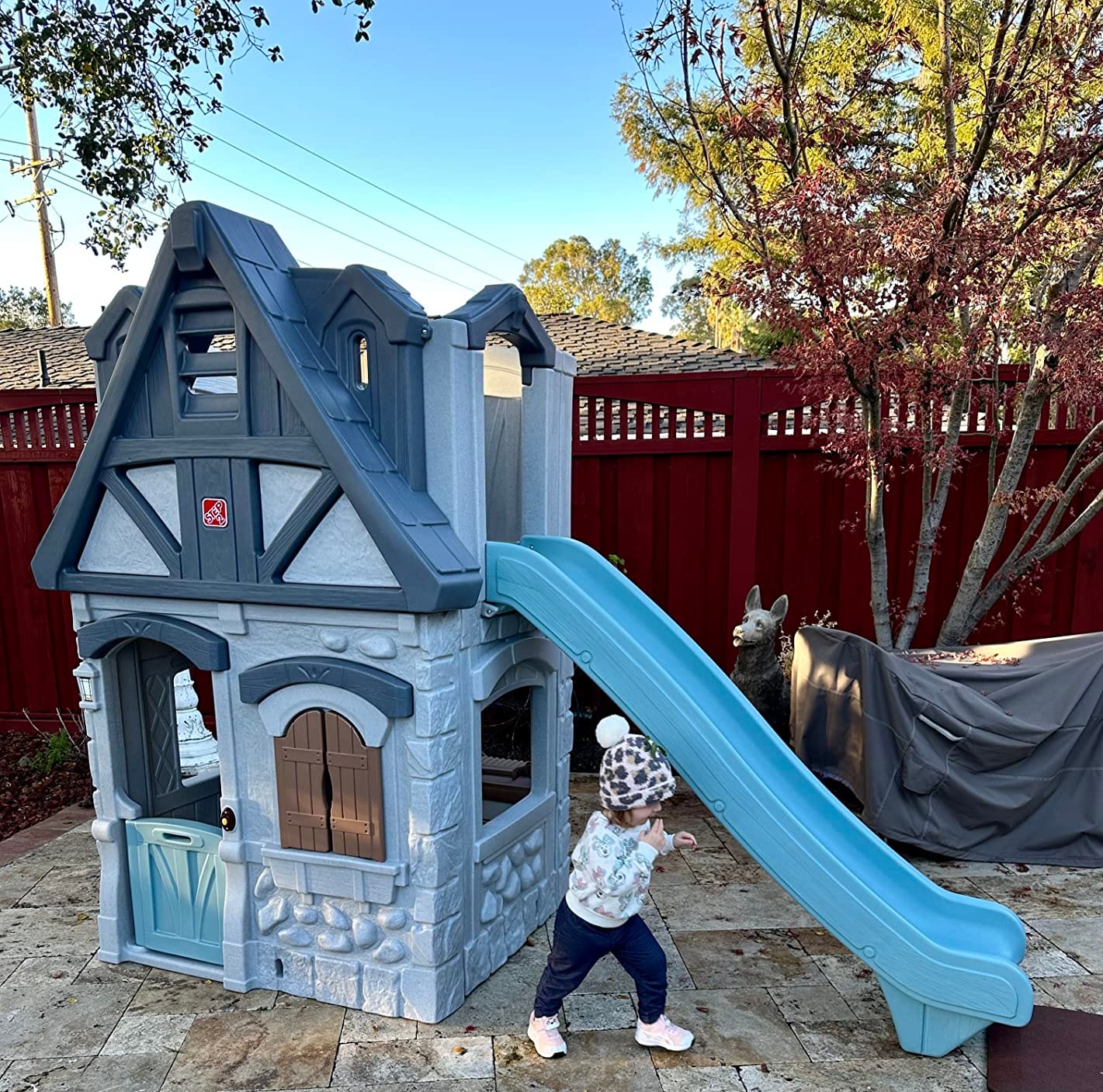
The lower level is spacious enough for two children or a child plus an adult, and it includes a sink, countertop, a working doorbell, a Dutch-style door and window shutters for role play. Storage or hideaway space sits underneath, with room for a sandbox.
This listing carries the highest rating in the group at 4.8, with 80 percent five-star feedback and no one-star ratings at all. Owners of 2-to-5-year-olds describe it as sturdy, spacious and easy to clean.
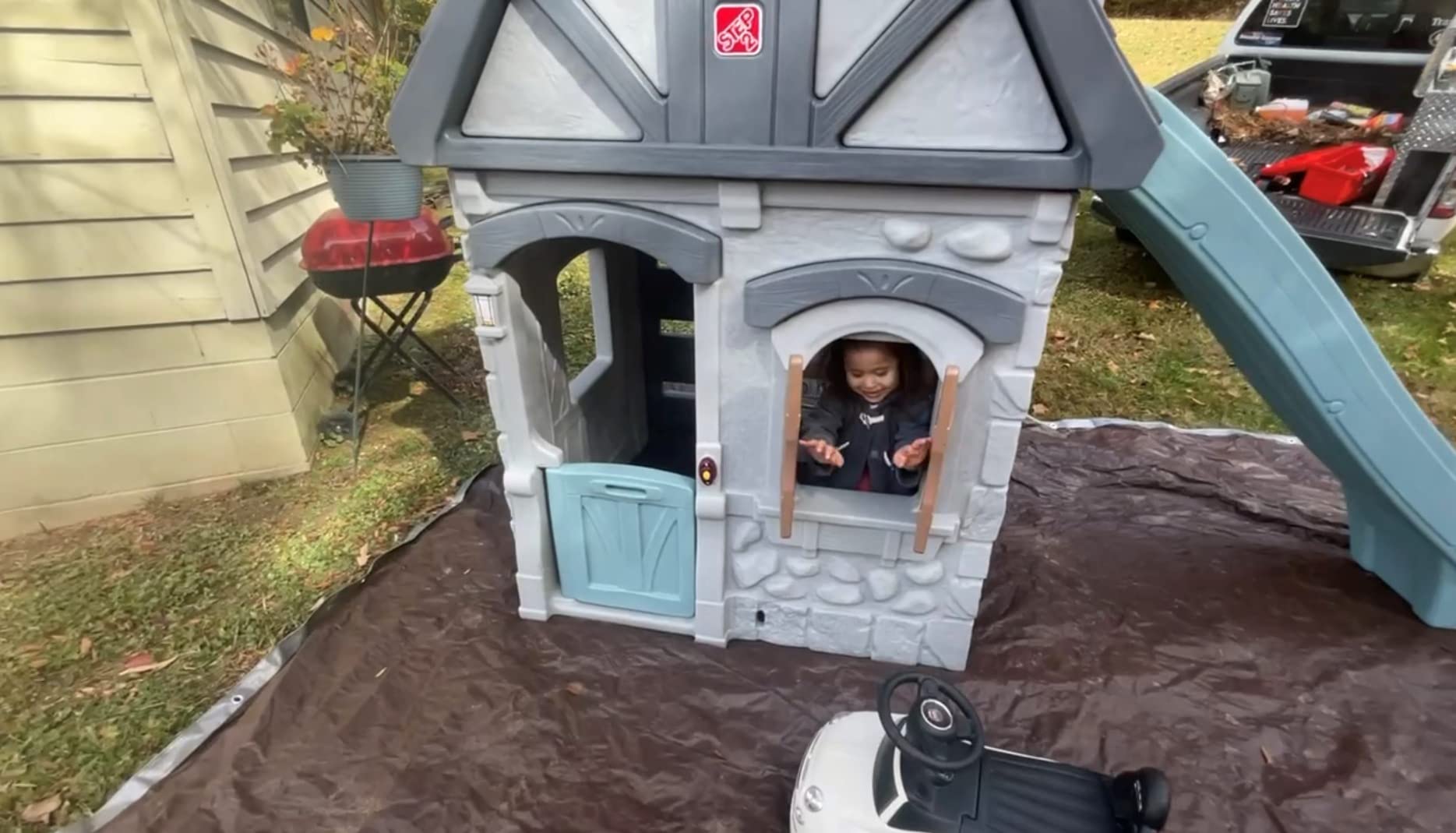
The recommended range is 4 to 8 years, so this is the pick when you want something a child will not outgrow at three. The fenced upper deck and the two-level layout keep it interesting well past the toddler years.
At 92 pounds it is heavy but manageable for two adults, and because it is plastic it can be hosed off rather than treated.
The access ladder is on the outside only, so a child on the upper level cannot climb back down from inside. That is a real constraint for a four-year-old who wants independence.
The slide is fairly steep and works best over a soft surface such as mulch or a sandbox rather than concrete. Assembly takes about two hours and is much easier with two people and a power screwdriver.

Ages 2-6
FSC-certified timber
82.7 L x 42 W x 38.4 H
52 lb
110 lb per child
Most wooden play sets in this category are built for children aged 5 and up. This one is the exception, sized for ages 2 to 5 and built from FSC-certified timber, which means the wood comes from responsibly managed forests and you can verify the claim rather than take it on trust.
The 5-in-1 layout packs a ladder, a rock wall climber, a 4-foot slide, a playhouse tent and a climbing structure into an 82.7 by 42 by 38.4 inch footprint. That is one of the most compact assembled sizes here relative to how many activities it offers.
Weight limits are unusually well specified for a toddler set. Each child supports up to 110 pounds with a 500-pound total capacity, and the recommended range runs from 24 months to 5 years.
At 52 pounds it is heavy for a wooden set but light enough that two adults can move it between a patio and a playroom, and the manufacturer describes it as usable indoors or outdoors.
The climbing stations are Montessori-inspired and meant to be physical exploration rather than a race to the top. For a two-year-old working on balance and coordination, that is a better fit than a tall slide with a queue.
The playhouse tent is not a solid house, so if a full enclosed den matters to your child, look at the Step2 options instead. What you get here is an open-sided fort within a compact wooden frame.
This listing carries a 4.3 rating from 35 reviews, with 58 percent five-star and 24 percent four-star feedback and no one-star ratings. The smaller the review count, the less settled the long-term durability picture, and that is worth factoring in for wood.
Wood components need periodic checking and tightening as the child grows and puts more load through the frame. Budget a few minutes each spring and fall rather than treating it as a set-and-forget purchase.
Plastic wins for the first three years and wood wins after that. Plastic is lighter, needs no treatment, resists fading and costs less to replace. Cedar and FSC-certified timber feel substantial, outlast plastic and can be handed to a second child, but they need annual attention and a bigger footprint.
For a two-year-old who will likely outgrow the structure in two to three years, plastic is the honest answer. For a child entering the preschool years with a four-year-old sibling in tow, a wood build is the one that survives the handover.
Leave clear space in front of the slide exit and on both sides of any climbing surface, and put something soft under the slide runout. Mulch, rubber surfacing or a sandbox all work, and bare packed dirt is better than gravel or concrete.
A useful rule is to add at least six feet of clear space around the slide and climb zones, then check the manufacturer’s stated fall zone for the specific model. Larger structures like the Step2 Enchanting Adventures need more, and the steeper its slide, the more runout space it requires.
Budget two adults and one afternoon for anything wood or anything with three or more modules. Plastic single-piece models like the Radio Flyer Pirate Ship need only a screwdriver. The gap between advertised and actual assembly time is the single most common complaint parents raise about wooden playhouses with slides.
Forum threads repeatedly report that a structure described as quick to build took much longer than expected and needed more tools than people had to hand. If you are not handy, check whether the listing ships pre-cut and pre-drilled, because that removes most of the difficult measuring and drilling work.
The most common owner theme is sizing anxiety. Parents ask repeatedly whether a set rated for ages 5 and up is safe for a 2- or 3-year-old, and the honest answer is that a lower minimum age marking does not make a high platform safe for a toddler.
Second, mixed reviews are the biggest source of frustration. Parents report being unable to find a clear winner on safety and durability across listings, which is why we listed weight limits, warranties and age bands explicitly for every pick above. Third, a parent whose 2-year-old loved slides chose a two-slide model after her toddler outgrew a plastic one, which is worth weighing if you have two children close in age.
The best playhouse for a toddler is a low-platform plastic structure with a short slide, easy-grip steps and a maximum weight limit above what your child weighs. For most families the Simplay3 Young Explorers Adventure Climber and Slide is the strongest all-round pick, with the Step2 Lookout Treehouse close behind on value.
Plastic is lighter, needs no annual treatment, resists sun fade and suits a two-year-old who will outgrow it in a few years. Wood feels substantial, lasts longer and can be handed down, but it needs periodic re-staining, tightening and more space. Choose plastic for the under-fives window, wood if a sibling will use it next.
Outdoor playhouses with slides are sold by general marketplaces, big-box home and toy retailers, and specialist outdoor toy stores. Each pick above links straight to its listing, and folding plastic models are also common on secondhand marketplaces once families are done with them.
A basic wooden playhouse built from timber and hardware is cheaper in materials than a ready-made structure, but the build takes most of a weekend plus tools and a safe roof or platform build. Ready-made models trade that weekend for a price that varies widely across plastic and cedar options.
Measure the assembled footprint, not the packaging size, then add roughly six feet of clear space around the slide exit and climbing zones. Compact plastic units run about 25 inches deep, while cedar and two-story structures can need 5 to 10 feet in every direction.
After weighing all eight, the Simplay3 Young Explorers Adventure Climber and Slide is our overall winner for the preschool band. It starts at 1.5 years, carries a 180-pound weight limit, offers a genuinely wide slide with easy-grip rails, folds into a footprint narrow enough for a side yard and passes through a standard doorframe when you need it indoors.
If your yard is tight or your budget is fixed, the Step2 Lookout Treehouse gives you the same core play pattern at 30 pounds and a three-year warranty. For renters and anyone who wants the structure to disappear between seasons, the Radio Flyer Pirate Ship folds flat with a carrying handle and needs only a screwdriver to assemble.
The real decision is not which model is best, it is how long your child needs it and how much space you can give it. Measure the assembled footprint plus clearance, check the weight limit against your oldest child, and confirm the minimum age rating covers the youngest one. Get that right and any of these eight will earn its footprint.
