
To clean a leather couch at home, vacuum or dust it first, wipe the surface with a microfiber cloth dampened in a few drops of mild soap mixed with distilled water, let it air dry away from sunlight, and finish with a leather conditioner. The whole job takes about 30 minutes for a three-seat sofa and no specialist equipment.
Leather punishes the wrong cleaner harder than any other upholstery. Dye lifts, pale patches bloom where the hide stayed wet too long, and a finish that has been over-wiped starts to crack within weeks.
Almost all of that is avoidable. The rule that matters more than any product: the cloth must be damp to the touch, not wet enough to squeeze.
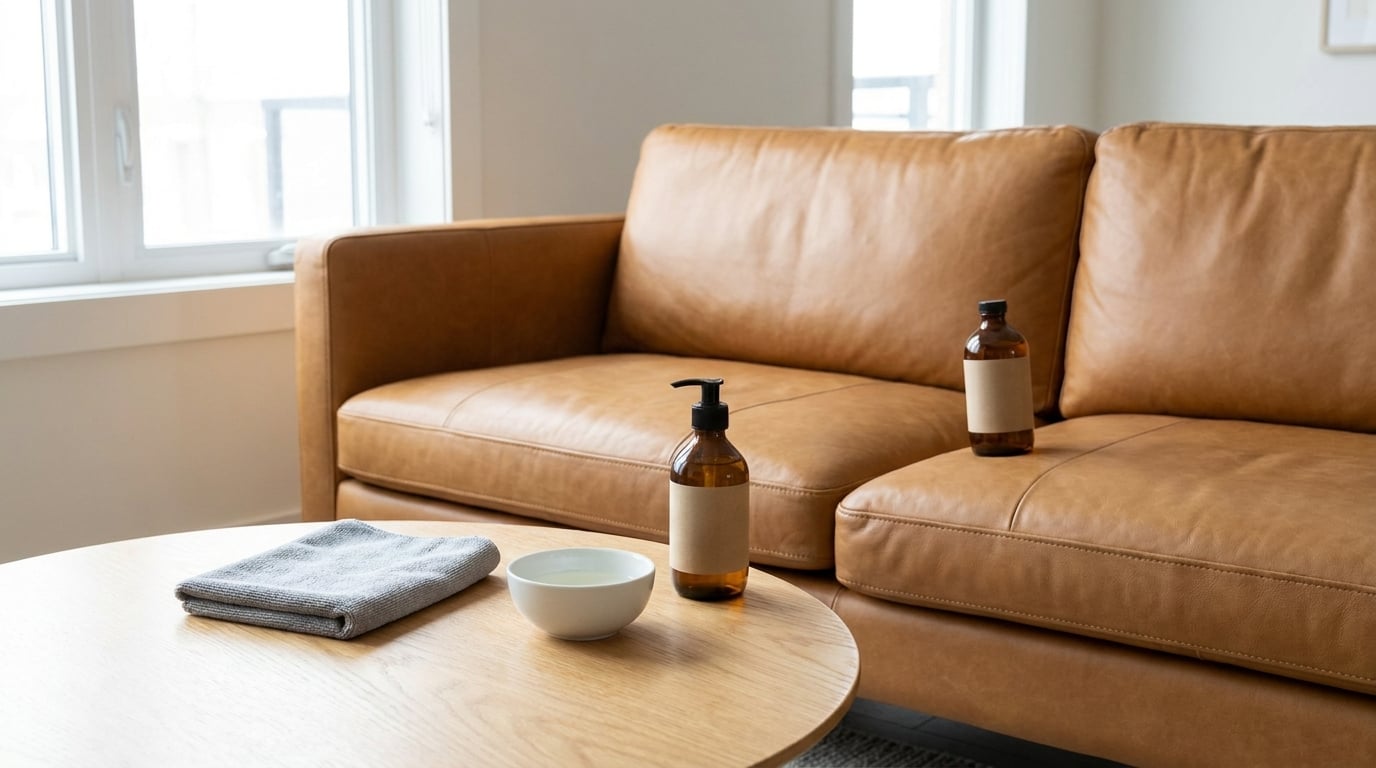
Gather these before you start, and read the care label under the cushions or on the frame before you mix anything. The label and the leather type decide which products are safe, and guessing wrong is how couches get stripped.
Two or three soft microfiber cloths. Cheap ones are fine. You want one for cleaning, one for rinsing, one for buffing, and you swap them rather than reuse a filthy one.
A small bowl and a spray bottle. The bowl for the cleaning solution, the bottle for a fine mist when you want to see where you have been.
Distilled or filtered water. Tap water carries minerals that leave dull rings as it dries. If you have none, our guide on making distilled water at home is the workaround I use.
A mild, unscented dish soap or a pH-neutral leather cleaner. Fragrance is the problem in most household soaps, not the soap itself.
A soft-bristled brush for seams, creases and cushion piping.
A vacuum with an upholstery attachment, or a stiff-bristled handheld brush if the sofa has no removable covers.
White vinegar for odour and light dye transfer, and baking soda for drawing smells out of the cushions.
A leather conditioner matched to the finish, plus a protector spray if the label allows one.
On a second-hand couch with no label, a pH-balanced leather cleaner on a soft cloth is the safest assumption for older hides, because it is designed not to disturb pigmentation.
Thirty seconds of identification saves you from the most common irreversible mistake. Finished leather behaves nothing like suede, and both behave nothing like faux leather.
| Leather type | How to spot it | What to use |
|---|---|---|
| Finished or pigmented | Even colour, slightly glossy, feels smooth with a fine grain | Mild soap and distilled water, then any conditioner |
| Aniline or semi-aniline | Marks change the colour instantly, surface looks raw and mottled | Gentlest possible cleaner, minimal moisture, spot test twice |
| Suede or nubuck | Soft, fuzzy, no sheen, marks show as nap changes | Dry brush and a suede-specific cleaner. No soaking, ever |
| Bonded leather | Thin, cool to the touch, edges look layered and fuzzy | Light soap only, no scrubbing, replace rather than treat if peeling |
| Faux leather or pleather | Uniform synthetic grain, often embossed, cold and plastic | Soap and water is fine, and vinyl-specific conditioner helps cracking |
The care code on the label is a quick second check. W means a water-based cleaner is allowed. S means solvent only, and water will stain. WS means either. X means vacuuming or a professional only.
If the label says S or X, stop there and do not apply water, whatever the hide looks like. A water mark on solvent-only leather does not lift out.
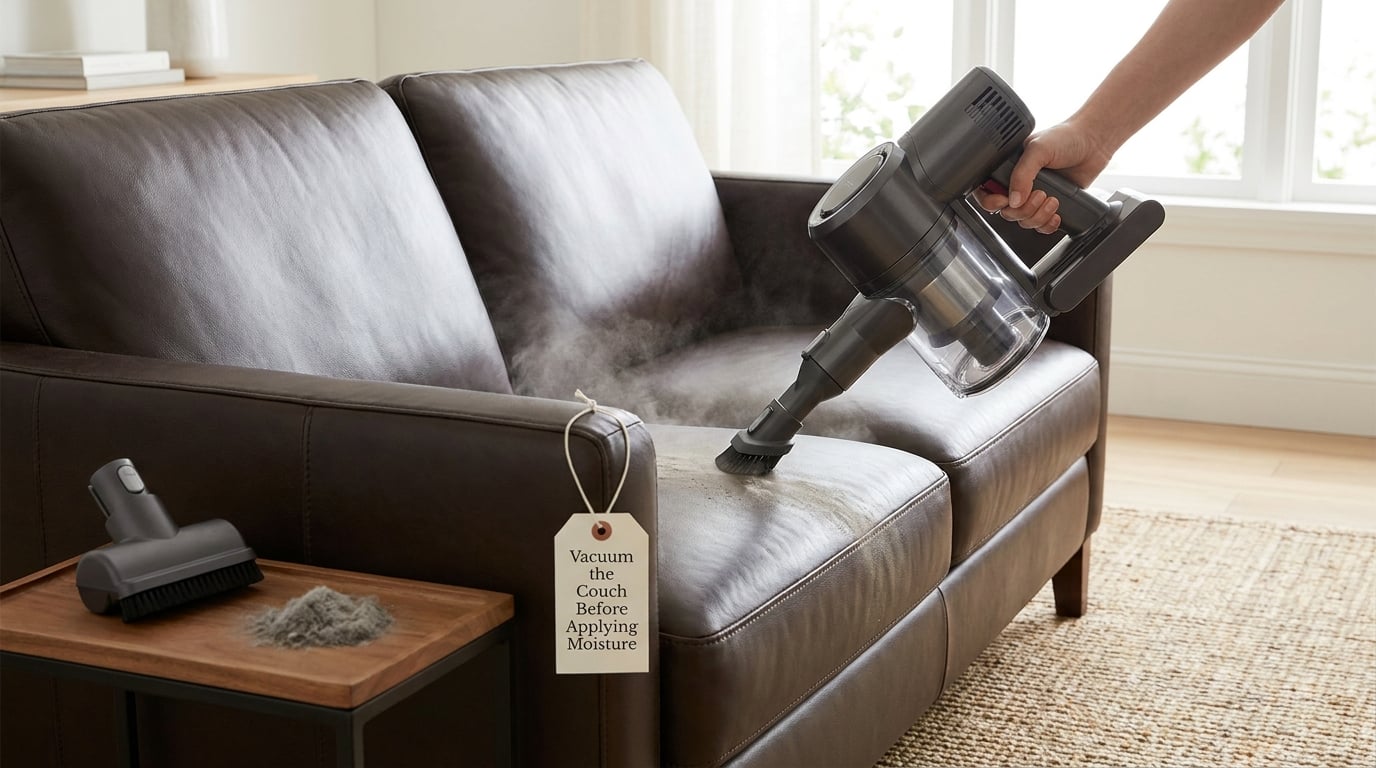
Dry first, wet second. Loose grit is the reason damp cleaning turns into a sanding job, because every particle you wipe gets dragged across the grain.
Run the vacuum upholstery tool over cushions, arms, the gap between cushions and along the base, then go back over the seams with the soft brush. Work the brush into piping and creases where grit collects.
How do you know it worked? The cloth you wipe the seam with afterwards comes away clean. If it comes away grey, keep vacuuming.
Mix a few drops of mild dish soap into a bowl of lukewarm distilled water. You want a solution that barely foams, not a bucket of suds.
Then patch test where nobody sits. Put a small amount on the back of a cushion or the underside of an arm, wait a few minutes, and check for colour lift, a darker patch or a dull film.
Any of those three means stop. Either dilute further or switch to a pH-neutral leather cleaner. Aniline leather deserves a test on a spot you will never see, because it accepts colour so readily.
Soak the cloth in the solution, then wring it out properly. The test is simple: hold the cloth over the bowl. If it drips, it is too wet.
Wipe in long overlapping strokes, section by section, cushion by cushion. Use overlapping passes so you are not re-wiping a wet stripe with a soaked stripe, which is how water rings form.
Keep the brush for seams. Around piping and in the crease where two cushions meet, a damp cloth will not reach, and grime left there is the first thing people notice later.
Change to a clean cloth dampened with plain distilled water for the second pass. That rinse pass is what stops a soapy film and the tacky feel that comes with it. Do not skip it even if the surface already looks clean.
Blot fresh spills. Do not rub, because rubbing drives the spill deeper into the grain and spreads the edge.
| Stain | Approach | Caution |
|---|---|---|
| Oil or grease | Absorb with a dry paper towel, then work in a small amount of plain soap on a barely damp cloth | Grease needs several passes. Skip it entirely on suede |
| Ink | Dab from the outside in with a cloth barely dampened with distilled water | Never use alcohol-based remover on coated leather, it lifts dye with it |
| Dye transfer from new jeans | Lightly dampen a cloth with a 1:1 mix of white vinegar and distilled water and dab | Test first. On cream leather a too-strong mix etches the finish |
| Pet urine | Blot with absorbent towels, then a vinegar and water solution, then dry thoroughly | The smell lives in the cushion foam, not the hide, so the couch must dry completely |
| Mould and mildew | Dry clean the area first, then a light vinegar solution on a cloth | Fix the humidity or it comes back within weeks |
| Blood | Blot cold water first, then a very dilute solution | Hydrogen peroxide can bleach light leather. Patch test or skip it |
| Red wine and coffee | Blot immediately, then treat as an ordinary grime pass with the soap solution | Older dried stains may need a commercial leather cleaner |
For odour, baking soda scattered over the dry cushion overnight and vacuumed off the next day pulls more out than scented sprays ever will, because the odour is usually in the foam and the sprayed fragrance only covers it.
Blot the surface with a clean dry cloth first, then let the couch air dry in a room with airflow. Keep it out of direct sunlight and away from radiators and vents.
Heat is what turns cleaning into damage. It drives water out of the hide unevenly, and that is what leaves pale rings and stiff patches.
How do you know it is finished? The leather should feel dry to the touch, look even under angled light, and bend the same way at the cleaned area as at an untouched one. If it looks dull or patchy, a second pass with a clean cloth and plain distilled water usually evens it out.
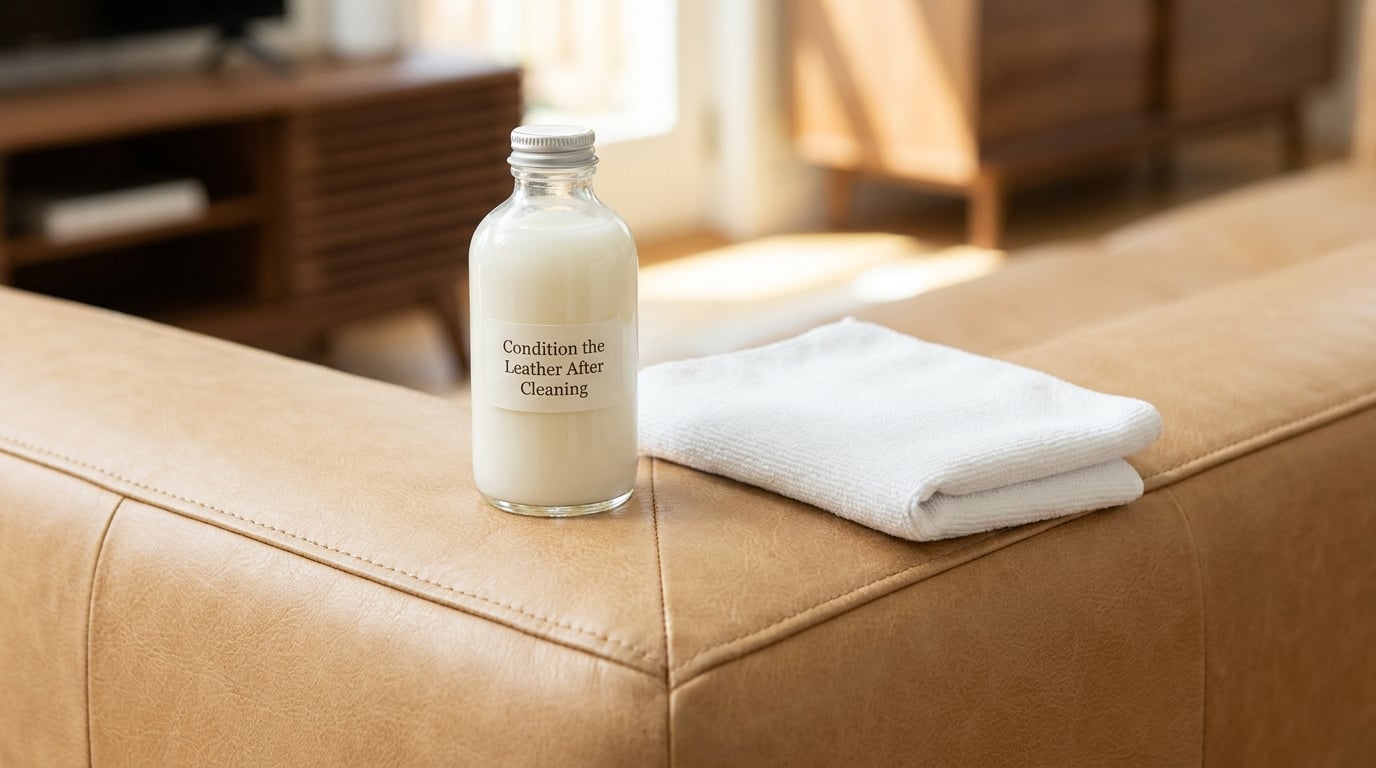
Cleaning removes the oils that keep leather supple, and dry indoor air removes the rest. Leather is a use-it-or-lose-it material, so the step people skip is the one that decides how the couch looks in three years.
Wait until the hide is fully dry, then put a small amount of conditioner on a clean cloth rather than spraying it directly. Direct spray pools in the seams and leaves a sticky residue that later looks like flaking.
Buff in overlapping circles until the surface goes from dull to a soft even sheen, and stop once it stops absorbing. Over-conditioned leather gets tacky within days and can begin to flake at the surface.
For a couch that has never been conditioned, expect the first application to disappear fast. A second thin coat the following week is normal and not a sign you did anything wrong.
After that, a thin coat every six to twelve months keeps the finish in decent shape, and a protector spray applied on top gives you a barrier to wipe spills off before they set.
Almost every leather sofa I have seen ruined was ruined by one of the products below, and nearly all of them are the single most-recommended item in the wrong forum thread.
| Do not use | What it does | Use instead |
|---|---|---|
| Bleach or ammonia-based window cleaner | Strips dye and dries the hide out permanently | Soap and distilled water |
| Undiluted dish soap | Leaves a waxy film that traps dirt and goes patchy | A few drops in a bowl of water, never straight on |
| Murphy’s Oil Soap | It is a wood-floor product. On coated leather it leaves a greasy film and can darken the finish unevenly | A pH-neutral leather cleaner |
| Magic Eraser | Melamine foam is abrasive. It will lift scuffs by taking a thin layer of finish with them, and the bald spot is permanent | A soft cloth and patience, or a repair kit for scuffs |
| Baby wipes | Most contain alcohol and preservatives that dry and dull coated leather | A microfiber cloth dampened with water |
| Alcohol and lighter fluid | Removes pigment and dulls the surface | Vinegar and water in small amounts |
| Silicone furniture polish | Builds a greasy film that yellows and collects dust | A leather conditioner matched to the finish |
| Soaking a wet cloth, a steam cleaner, or a wet vac | Water sits in the seams and wicks outward as it dries, leaving rings and stiff patches | A wrung-out cloth, worked in sections |
Two more errors have nothing to do with products. Skipping the patch test is how a good result turns into a pale blotch, and cleaning suede with a wet cloth at all is a repair job rather than a cleaning job.
On upkeep, the routine matters more than the deep clean. Vacuum weekly, wipe with a dry cloth monthly, condition two or three times a year, and wipe spills within a few minutes. If you are choosing between materials for a new sofa, our non-toxic couch picks cover what to look for in the finish itself.
The safest method is a damp cloth, not a wet one. Vacuum first, mix a few drops of mild unscented dish soap into lukewarm distilled water, wring the microfiber cloth until it does not drip, and wipe in overlapping strokes section by section. Dry with a clean cloth, air dry away from sunlight, then buff in a conditioner matched to the finish. Patch test on a hidden spot before anything touches the hide.
Yes, on finished and pigmented leather, and on most faux leather, as long as the cloth is damp rather than wet. Water is a poor choice for suede and nubuck, and on aniline leather it can leave rings, so use the least amount that does the job. If the care label carries an S or a solvent code, water will stain the hide and no amount of drying will fix it.
These two need opposite methods. Suede and nubuck stay dry: brush with a soft-bristled brush in the nap direction, blot marks with a barely damp cloth, and use a cleaner sold for suede. Never saturate the nap, because the water line stays visible. Faux leather and pleather take soap and water like a vinyl surface, then benefit from a vinyl conditioner once dry to slow cracking.
A damp wipe with good airflow is usually dry to the touch in two to four hours. A soaked area, or a cushion that held a spill, can take a full day or two. Keep it away from direct sun, radiators and vents the whole time, since heat drives the water out unevenly and causes the pale rings people try to clean off again. A small fan in the room shortens the wait.
Stop and call a specialist if the finish is already peeling, flaking or cracking, because cleaning will not restore a failed topcoat and rubbing it makes things worse. The same applies to deep-set grease, an ink stain that has soaked through, mould that keeps returning, or a care code of X. An unlabelled second-hand couch with a valuable hide is also worth paying for, since pigment damage is expensive to reverse.
The safe sequence is short: identify the finish, read the care code, vacuum, patch test, wipe with a cloth you have wrung out until it does not drip, rinse with plain distilled water, air dry away from heat, and condition once the hide is dry.
Start tonight with the label under the cushions. Find the code, match the leather to the type table, and test your cleaner on a spot nobody sits on. That five minutes is what keeps the rest of the job reversible.
