

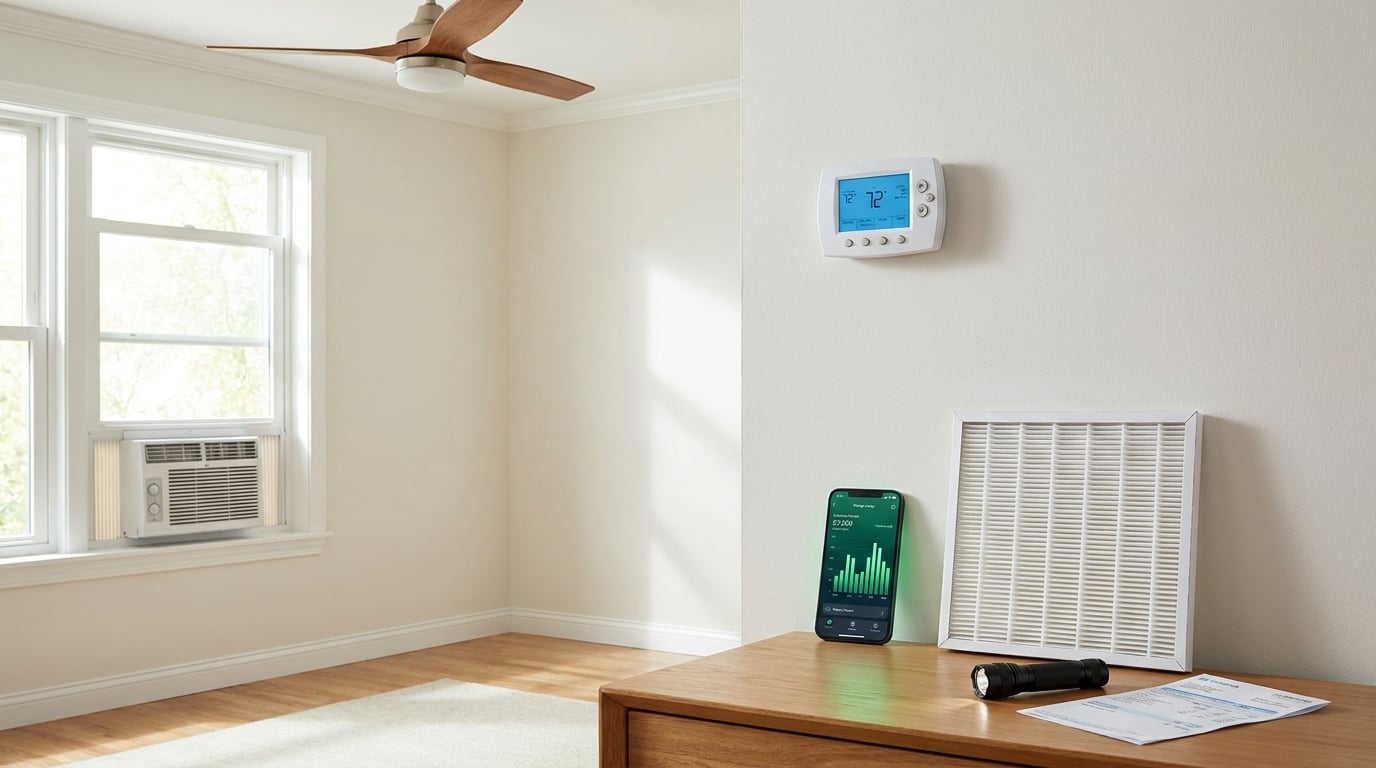
The fastest way to lower your electric bill in summer is to stop fighting the weather at the thermostat: set it to 78°F when you are home, 85°F when you are out, and let a ceiling fan handle the rest. Air conditioning is the largest electricity load in most homes, and the U.S. Department of Energy puts it at more than half of a typical summer bill. Everything below is ordered by how much it actually moves that number.
Most of the advice you will find online treats every tip as equal. They are not. Changing your thermostat and sealing up air leaks work on the physics of the house, so they compound every single day of the season. Switching off a lamp in an empty room does almost nothing by comparison, no matter how many times the list tells you to do it.
Read this once, then act on it in order rather than in pieces. The most common mistake is doing the easy habits for a month and never touching the thermostat, the filter, or the bill itself.
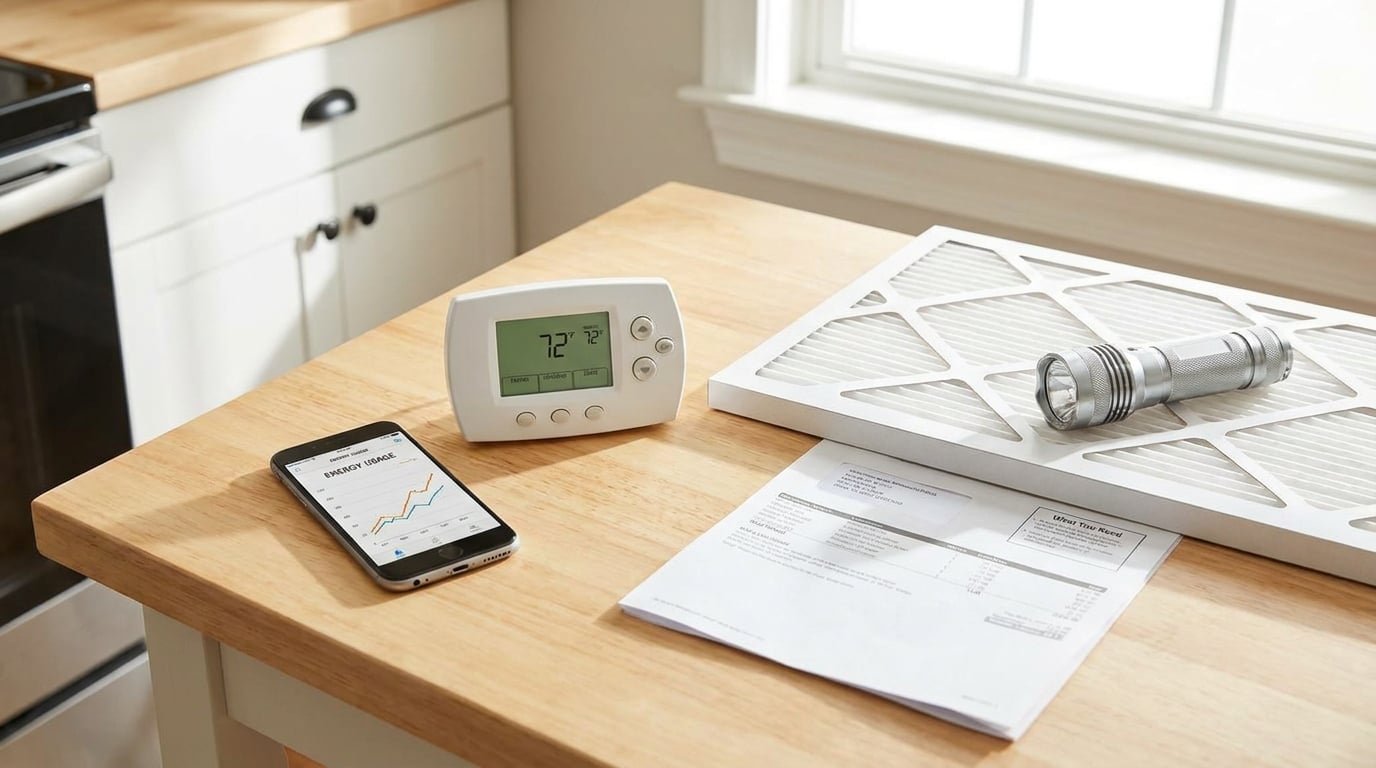
You can do this whole plan with things you already own. Gathering them first means you are not making a second trip to the hardware store in July.
Twelve months of bills. Not just the last one. Pull up the last summer and the summer before it, and note the kilowatt-hour total, the rate per kilowatt-hour, and the dollar figure for each. A bill line you cannot find is a line you cannot check, and most utilities print the breakdown on page two.
A working thermostat you can actually program. Most digital thermostats built since the 2010s have a schedule buried two menus deep. If yours only has a temperature dial, note the model number off the back before you shop, because a basic programmable model is inexpensive and pays for itself quickly.
A flashlight and a screwdriver. The filter compartment and the outdoor condenser are both in awkward, poorly lit spots. A headlamp is better, since you need a free hand.
The correct filter for your system. This is the step people get wrong most often. A filter that is too small lets dirty air past the coil, and a filter that is too thick chokes airflow. Look for the size printed on the filter frame inside the unit, or in the manual, rather than guessing by model.
A plug-in energy monitor. A simple inline meter that shows live watts costs very little and tells you instantly what a television, a game console, or a space heater is drawing while it runs. This is the fastest way to find the appliance nobody is suspecting.
Your utility account login. Most utilities offer a free online dashboard with hourly or daily usage, plus rate-plan details and rebate listings. If you have never signed in, do it before the first hot week, not during it.
One more thing worth having on hand: a notebook. Write down the date each change, so when the next bill arrives you can attribute the difference to something specific instead of guessing.
While you are gathering tools, you may also be thinking about the water heater, which shares a water bill and a lot of the same energy logic. Cutting water use at home is the subject of its own piece.
Here is the order I would work in. The first three entries change the load itself. Everything after them trims the margin.
Set the thermostat to 78°F when you are home and 85°F when you are out. The U.S. Department of Energy recommends 78°F rather than 75°F, and the commonly cited figure is roughly 10% a year. Forum users on r/Frugal report running a single zone at 85°F during the day and 83°F overnight, which is a reasonable working number for a two-story house.
Program a schedule and then stop touching it. Constant manual adjustment makes the system work harder, because the compressor restarts each time the set point moves.
Clean or replace the HVAC filter every 30 to 60 days. A restricted coil uses more electricity for the same cooling. This is the cheapest efficiency gain available to most people.
Give the outdoor condenser clearance and shade. Clear at least two feet of clearance in every direction. Direct sun on the outdoor coil can cut efficiency by around 10%, according to contractors quoted by This Old House.
Close the blinds and curtains on sun-facing glass. Blocking solar heat before it reaches the glass is far more effective than cooling it after it is inside.
Seal the air leaks. Door sweeps, weatherstripping on window sashes, and caulk around framing are cheap. Weatherstripping is regularly credited with savings of up to 10% a year.
Use fans, and switch them off in empty rooms. A ceiling fan moves air across your skin, which makes a higher thermostat setting feel cooler. It does not cool the room.
Shift laundry, dishes, and any large load away from the evening peak. If you are on a time-of-use rate, this is where the money is.
Cut standby power and finish the lighting changeover. LED bulbs use up to 80% less energy than incandescent, and the old ones add heat to the room as well as light.
Two useful terms before the detail. A kilowatt-hour is what you are actually billed for: how much electricity you used, independent of any rate. A time-of-use rate charges a different price per kilowatt-hour depending on the hour, which is why 10 p.m. and 6 p.m. can cost very different amounts for the same appliance. Once you can separate usage from rate, the bill stops being mysterious.
Set it to 78°F and leave it. That single number is the difference between a house that costs what it should and one that does not, and the reason is simple: every degree of indoor air you remove has to be pumped out by the compressor, which means more kilowatt-hours.
When you are out for the day, raise the set point rather than shutting the system down completely. A heavily insulated house loses its cool air slowly, and a compressor restarting against a fully hot house burns a lot of power in the first hour. Leaving the system running at 85°F is usually cheaper over a nine-hour absence than cycling it off and on.
Run the fan on auto with the cooling mode. In air conditioning the fan circulates air over the cold coil, which is what gets you to feel comfortable at the set point. A higher fan speed feels nicer but adds a small, constant load and does not lower the temperature.
Ceiling fans help more than most people expect. Moving air across skin evaporates sweat, so a room at 80°F with a fan running reads as several degrees cooler. That comfort is the point, because it lets you hold a higher thermostat setting without feeling it. Set the fan to counterclockwise for summer so the air moves up and over the center of the room, and switch it off whenever the room is empty.
How do you know a change worked? Leave the thermostat alone for at least a week, then check the daily usage graph in your utility account. Comparing the same week against the week before is more useful than comparing a hot July to a mild June.
A restricted air filter is the most common reason a working air conditioner burns extra electricity. When the filter clogs, the fan has to push harder to move air across the coil, and the coil gets colder, which is exactly how you end up with condensation or ice on the refrigerant lines.
Check the filter monthly in summer. If it is washable, wash it with cool water and let it dry fully before it goes back in. If it is disposable, replace it. If you see dust bunnies on the outdoor coil, a hose and a soft brush will clear a surprising amount of airflow blockage, with the system switched off at the breaker first.
Do not open the refrigerant lines, add refrigerant, or run the system with the electrical cover off. Refrigerant work requires licensed HVAC technicians with the right gauges and recovery equipment, and electrical work on the condenser requires a licensed electrician. If the system is short on refrigerant, ice up, blowing warm air, or tripping a breaker, that is a professional call, not a weekend project.
Zone the house rather than cooling everything. Closed interior doors matter more than most people assume, because they keep conditioned air where you are instead of letting it slide into rooms you never sit in. On a second story, closing the stair door at the top is a cheap way to keep cool air down below.
Sun-facing windows are the other half of the fight. Insulating curtains with a lined or blackout fabric do a noticeably better job than decorative sheers, and some people in r/Frugal layer a second fabric curtain behind the first. Close them before the sun reaches the glass in the morning rather than when the room is already hot.
Ventilate the right way. A bathroom or kitchen exhaust fan running during and after a shower or a cook pulls heat and humidity out of the house, which lowers what the air conditioner has to remove. A window air conditioner or a portable unit in a closed room is far more efficient than a central system trying to cool the entire square footage.
Once cooling is under control, the next tier is everything that runs constantly. These loads are not dramatic, but they are permanent, which makes them worth auditing twice a year.
Refrigerator and freezer. The FDA advises keeping the fridge at or below 40°F and the freezer at 0°F for food safety. Many households run several degrees colder than that out of habit, and every extra degree makes the compressor work longer. Confirm the temperature with a fridge thermometer rather than trusting the dial.
Standby power. Televisions, game consoles, set-top boxes, printers, and kitchen gadgets draw a small amount continuously and add up across dozens of devices. Plug a media center into a power strip and switch the strip off when you are done, rather than chasing each device with its remote.
Lighting. An LED bulb uses up to 80% less energy than an incandescent, and it also runs far cooler. r/Frugal posters make the same point from the other direction: an incandescent bulb is a small heater in your room, so the cost of running it shows up twice, once on the bill and once as extra load on the air conditioner.
Cooking. An electric range heats a kitchen that is already the warmest room in the house, and the air conditioner then has to remove that heat. Grilling outside, cooking cold meals, or using the microwave for smaller portions keeps heat out of the house in the first place.
Laundry. Wash in cold water, run full loads, and clean the lint screen after every cycle. Running the dryer for one shirt costs nearly the same as a full load. Where the climate allows, line-dry outdoors and line-dry towels indoors in a dry house rather than in a humid one.
Pool and outdoor equipment. A pool pump and a filtration system are easy to forget and often run for hours. Programming them for early morning, plus keeping a grill, a dehumidifier, and any workshop equipment off during the hottest part of the day, trims a load that never shows up in anybody’s mental accounting.
A plug-in energy monitor makes this section fast. Measure the actual draw of a device while it runs, and write the number next to the device. Anything drawing far more than you expected is a conversation with the utility about whether it should be replaced, and if so, with a secondhand unit or a properly sized replacement rather than a bigger one.
Summer bills follow the weather, not your intentions. A single stretch of unseasonably hot days can add more than a month of careful habits will ever save, and it is worth separating those two effects so you do not abandon a plan that is working.
Stagger large loads so they do not all run at once. Laundry, the dishwasher, and the pool pump on a schedule that spreads them across the day reduces both your total and your peak draw, which matters enormously if your rate plan charges more for the hours of highest demand.
On a time-of-use plan, the cheapest hours are usually late evening through early morning. Schedule the dishwasher to run after bedtime, start the washing machine before work, and charge an electric vehicle overnight. Check your specific plan for the exact off-peak window, because it varies by utility and by season.
Read your bill line by line, not just the total. The kilowatt-hour figure is one line. The price you paid per kilowatt-hour is another, and on the same bill you will usually find transmission and distribution charges, a demand-related cost, and a fixed service or availability charge. The last three do not change when you use less power.
This is where a bill increase gets misdiagnosed. If the kilowatt-hour number held steady and only the rate moved, your habits are not the problem. Regional peak demand, fuel costs, transmission expenses, and local distribution maintenance all feed into that rate, and utilities adjust them independently of what any individual household does. The U.S. Energy Information Administration publishes regional and national price data, and your state public utility commission publishes the rate decisions that set yours.
Set up a monthly check-in. Note the total, the kilowatt-hours, and the rate per kilowatt-hour for June, July, and August each year, and put them next to each other. Three data points make a trend visible in a way a single bill never will.
Two more levers live on the utility side, and both are free to ask about. Bill assistance and medical-necessity or protection tariff programs exist for households that qualify, and enrolling takes a phone call rather than a lawyer. Demand response and thermostat curtailment programs let you let the utility nudge your system up a degree during a grid stress event, usually for a small credit on your bill. Ask your utility whether either is available in your area, and check the ENERGY STAR and utility rebate listings before replacing any large appliance.
Setting the thermostat to 72°F because it feels more comfortable. Every degree you remove has to be pumped out by the compressor. The widely cited rule of thumb is that each 1 to 3 degrees of adjustment moves the bill roughly 1 to 5%, so a three-degree change is worth real money over a season.
Switching the air conditioner off completely for a few hours. For a well-insulated house, raising the set point to 85°F beats a full stop-and-restart cycle. Repeatedly cooling a house that has heated up wastes the first hour of compressor time.
Running fans in empty rooms. A ceiling fan costs very little, but it cools people, not air. In an empty room it just moves heat around and costs money for no benefit.
Leaving the outdoor condenser boxed in by a deck, a shed, or shrubs. It needs clearance in every direction, and it needs shade without being covered.
Believing a smart thermostat saves money on its own. The savings come from the schedule, not the device. A smart thermostat left on a single constant set point does exactly what a dumb thermostat does. Program it, or it is an expensive paperweight.
Turning the water heater down. Pushing it below the standard 120°F setting risks scalding and creates a scald hazard, and very hot water is sometimes recommended specifically to limit Legionella growth in storage tanks. Leave the temperature alone and reduce hot water use instead, which the water-saving fixes cover in detail.
Running the oven to heat the house in winter and assuming the reverse works. Heat pumps deliver far more heat per unit of electricity than resistance heat. If cooling is expensive in your region, a properly sized heat pump system is worth a serious quote, and the ENERGY STAR label plus the SEER rating are the numbers to compare.
Treating a comfort cutback as a free option. If anyone in the house is an infant, an older adult, pregnant, or medically vulnerable, indoor temperature is not a budget line. Keep the house safe first. Know the warning signs of heat illness, which include confusion, fainting, and very hot dry skin, and call emergency services right away rather than trying to cool someone down on your own.
Raising the set point from 72°F to 78°F is the single highest-leverage change most households can make. The U.S. Department of Energy recommends 78°F rather than 75°F, and the commonly cited saving is about 10% a year on cooling. A widely used rule of thumb puts each 1 to 3 degrees of adjustment at roughly 1 to 5% off the bill. The key is to set it once and stop adjusting it.
A fan uses far less electricity than a full cooling cycle, so leaving it on is not what drives your bill. In air conditioning mode, the fan moves air across the cold coil, which is what makes the room feel comfortable at the set point. Setting the fan to a higher speed adds a small constant load and does not lower the temperature at all. Auto is the sensible setting.
Fans first, air conditioner second. A ceiling fan moving air across your skin makes a room read several degrees cooler, which lets you hold a higher thermostat setting without feeling it. A window air conditioner cooling one closed room is far more efficient than a central system cooling the whole house. Fans cannot lower air temperature, so once it is genuinely hot outside, the compressor has to take over.
Only if you actually program it. The savings come from the schedule that keeps the system at 85°F while you are out, not from the device itself. A smart thermostat left on one constant temperature does exactly what a basic model does. A programmable model gets you most of the benefit for far less, and any of them will pay back quickly if you are not already scheduling.
Check the kilowatt-hour line and the rate line separately. If your usage held steady but the price per kilowatt-hour rose, the increase came from the supply side: regional peak demand, fuel costs, transmission expenses, and local distribution maintenance all feed into that rate and change independently of your habits. Fixed service and demand charges do not fall when you use less power either.
Call a licensed HVAC technician for anything involving refrigerant, including a low charge, ice on the lines, or air that blows warm. Call a licensed electrician for a burning smell, a scorched capacitor, a tripped breaker, or any work on the electrical cover. Replacing a filter, clearing a coil, rinsing a washable filter, and adjusting a thermostat are the jobs that are safe to do yourself.
Do three things this week. Set the thermostat to 78°F and program 85°F for the hours you are out, clean or replace the HVAC filter, and clear two feet of clearance around the outdoor condenser. Those three change the load itself, and the rest of this guide only trims around the edges.
Then read the current bill line by line and record the kilowatt-hours and the rate separately. When the next summer bill arrives, compare those two numbers rather than the total, so you can tell your own changes apart from a rate change you had no control over.
Keep refrigerant, wiring, and any electrical work for licensed HVAC and electrical professionals, and never trade indoor temperature safety for savings in a house with infants, older adults, or anyone medically vulnerable. If you want to go further on the water side of the utility bill, that is a separate set of habits.
